Credit: BBC
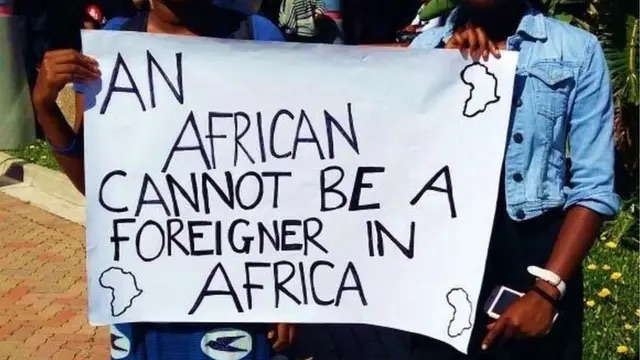
Human Rights Watch has accused authorities in South Africa of failing to respond adequately to a renewed wave of xenophobic attacks targeting African and Asian foreign nationals.
In a report released on Wednesday, the rights organisation said vigilante groups have carried out violent attacks, intimidation, and harassment with limited intervention from law enforcement agencies. According to HRW, while South Africa’s constitution protects the right to protest, such rights cannot be used to justify violence against migrants, refugees, and asylum seekers.
The report specifically points to the activities of groups such as “March and March,” which have been linked to anti-foreigner demonstrations and aggressive rhetoric. Human rights advocates warn that public hostility toward foreign nationals is becoming increasingly normalised in parts of South African society.
A Recurring Crisis
Xenophobic violence is not new in South Africa. Over the years, waves of attacks have repeatedly targeted migrants from countries such as Nigeria, Zimbabwe, Somalia, and Ethiopia. Shops have been looted, businesses destroyed, and lives lost.
These incidents often emerge during periods of economic frustration, unemployment, and social tension. Foreign nationals are frequently blamed for crime, job scarcity, and pressure on public services, despite limited evidence supporting many of these claims.
The Contradiction of Ubuntu
What makes the situation particularly troubling is the contradiction between xenophobic violence and South Africa’s long-standing promotion of Ubuntu, the African philosophy centred on shared humanity and communal dignity.
Many African observers argue that hostility toward fellow Africans undermines Pan-African ideals and weakens continental solidarity. During the anti-apartheid struggle, several African countries supported South Africans politically, economically, and diplomatically. The current attacks therefore carry emotional and historical weight across the continent.
A Leadership and Governance Challenge
Critics increasingly argue that the problem is no longer simply about isolated violence. It is becoming a governance issue.
Human rights groups maintain that inconsistent policing and weak accountability have allowed anti-foreigner rhetoric to grow with insufficient consequences. If authorities fail to act decisively, vigilante behaviour risks becoming further entrenched.
There are also broader economic concerns. South Africa remains one of Africa’s largest economies and depends significantly on regional trade, labour mobility, and continental cooperation. Persistent xenophobic violence damages the country’s image and raises concerns about safety, stability, and African integration.
Beyond Blame
Addressing xenophobia requires more than policing alone. Economic inequality, unemployment, misinformation, and political rhetoric all contribute to social hostility. But frustration cannot become justification for violence against vulnerable communities.
At a time when Africa is discussing free trade, continental integration, technological progress, and regional cooperation, repeated attacks on fellow Africans expose a deeper contradiction within the continent’s political and social reality.
The real challenge for South Africa now is whether it can confront xenophobia not only as a security issue, but as a moral, political, and continental crisis that threatens the very ideals of African unity it once helped inspire.